
On this page 10 sections
- What the National ICV Programme Is
- Who Needs an ICV Certificate
- How the ICV Score Is Calculated
- Worked Example: A Service Company
- Validity, Renewal and Which Accounts Count
- How to Get an ICV Certificate: 7 Steps
- ICV Certificate Cost
- How the Score Is Used in Tenders
- Common Mistakes
- What is not published
This guide explains the UAE’s National In-Country Value (ICV) certificate: what the score measures, who asks for it, how it is calculated, how long it stays valid, what it costs and how it is used in tenders. Every figure comes from the Ministry of Industry and Advanced Technology (MoIAT), the Ministry of Finance or ADNOC, read on 5 October 2026.
What the National ICV Programme Is
The National In-Country Value Programme is run under the supervision of MoIAT (UAE Government portal u.ae, page updated 30 December 2024). Its aim is to redirect more of the procurement spending of government entities and large national companies into the UAE economy. ADNOC started the programme in 2018 for its own suppliers; according to ADNOC’s ICV page, MoIAT took it national in 2021 as the National ICV Programme.
The programme has three groups of players, as defined in MoIAT’s ICV Certification Guidelines for Suppliers (September 2025):
- Participating entities: government entities and companies that have implemented ICV in their purchasing. MoIAT reported 31 local and federal government entities and major national companies by the end of the first half of 2024.
- Suppliers: the legal entity that obtains the certificate.
- Certifying bodies: professional services firms empanelled and authorised by MoIAT to verify the figures and issue the certificate. Our separate guide on ICV certifying bodies covers the official list.
MoIAT’s public directory listed 8,701 companies with valid ICV certificates on 5 October 2026.
Who Needs an ICV Certificate
MoIAT’s partner information kit (June 2021) says participation is optional for suppliers, but certificate holders gain an advantage in contract awards and purchase orders. In practice the certificate matters if you sell, or want to sell, to:
- Federal government entities. MoIAT and the Ministry of Finance announced on 21 December 2021 that ICV now applies to the procurement policies of all 45 federal government entities. In August 2025 the Ministry of Finance said it had contributed to circulars requiring suppliers to submit valid ICV certificates for all tenders.
- ADNOC and its group companies. ADNOC’s FAQ confirms it accepts the unified MoIAT certificate and applies it in tenders under its own ICV Implementation Guidelines. See our ADNOC supplier registration guide.
- Other participating entities. MoIAT’s 2024 supplier session slides show logos including Etihad Rail, Mubadala, Masdar, TAQA, Aldar, Emirates Global Aluminium, EDGE, e&, the Abu Dhabi Department of Health and Rafed.
One certificate is valid with every participating entity: ADNOC’s FAQ says a supplier issues one ICV certificate per legal entity, and each entity then uses it under its own policy. Registering as a vendor is a separate step; our vendor registration guide covers the main government and corporate portals.

How the ICV Score Is Calculated
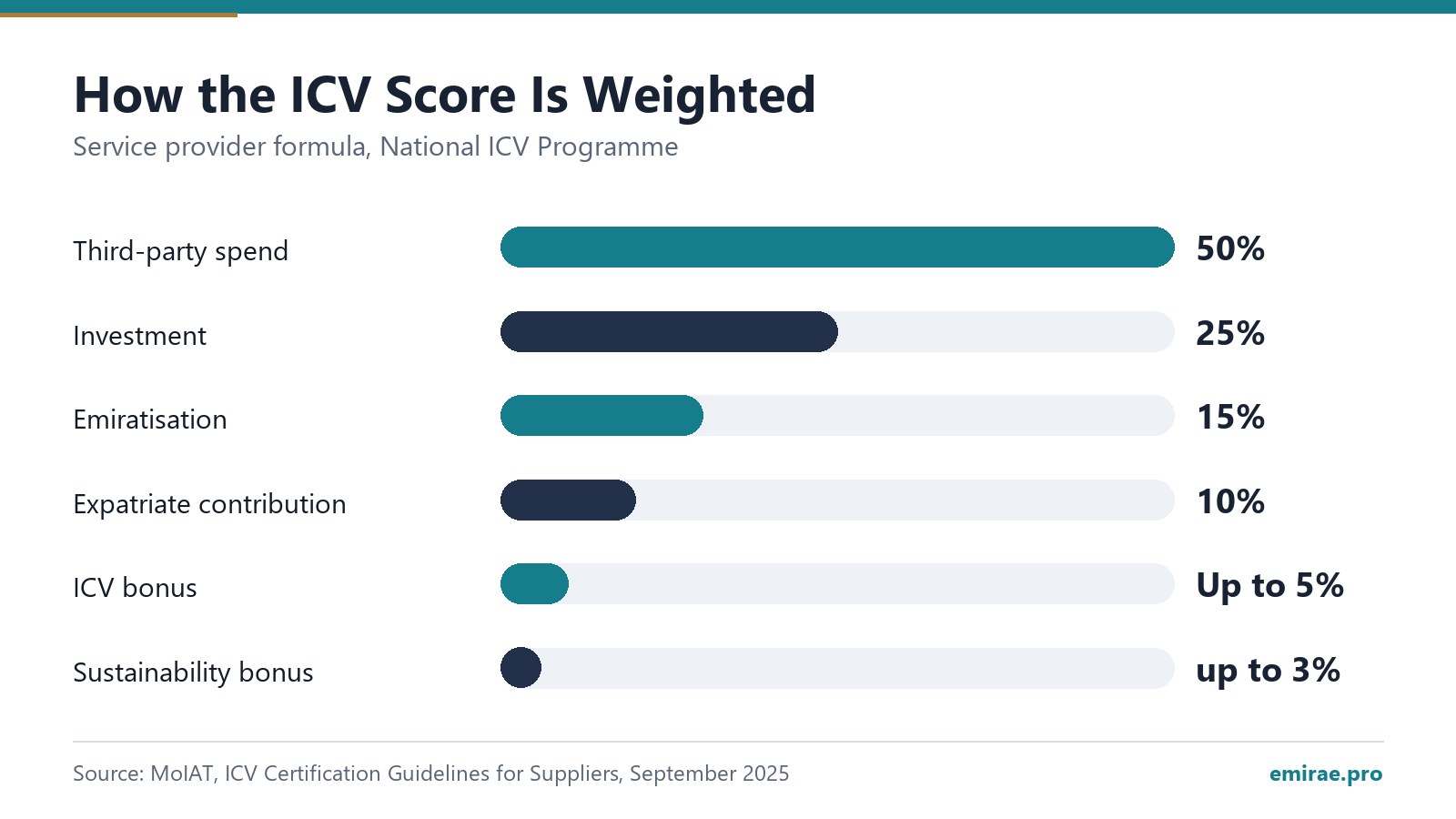
MoIAT uses two formulas. A company holding an industrial licence is a goods manufacturer; every other licence holder, including traders and agents, is a service provider. The weights below are printed on MoIAT’s ICV Formula page and in the September 2025 guidelines.
| Component | Service provider | Goods manufacturer | How it is measured |
|---|---|---|---|
| Spend in the UAE | Third-party spend: 50% | Manufacturing cost: 50% | Local spend plus Emirati cost plus 60% of expatriate cost, divided by total cost |
| Investment | 25% | 25% | 10% x (UAE assets / total assets, net book value), plus up to 15% progressive: AED 5 to 50 million = 5%, 51 to 100 million = 5%, 101 to 150 million = 5% |
| Emiratisation | 15% | 15% | Up to AED 200,000 of Emirati salary, training and benefits = 2%; progressive above that up to AED 20 million = 2% to 15% |
| Expatriate contribution | 10% | 10% | 1 to 5 expats: 1% to 3%; 6 to 50: 4% to 6%; 51 to 200: 7% to 9%; above 200: 10% |
| ICV bonus | Up to 5% | Up to 5% | Export revenue share, number of Emiratis / 100, growth in UAE assets (each x 5%, total capped at 5%) |
| Technology and sustainability bonus | Sustainability bonus: up to 3% | Advanced technology and sustainability bonus: up to 6% | Service providers: 0.5% for each of four sustainability policies plus 1% for ISO 14001, 14046 or 50001. Manufacturers: up to 5% from the Industrial Technology Transformation Index plus 1% for ISO or the Green Industries Label |
Source: MoIAT ICV Formula page and ICV Certification Guidelines for Suppliers (September 2025), read on 5 October 2026.
The biggest block, third-party spend, depends on who you buy from. Each purchase is multiplied by the vendor’s own ICV score. The guidelines set fixed values for some vendor types:
| Type of vendor | ICV % used |
|---|---|
| Water and electricity | 80% |
| Rent paid for property or land | 80% |
| UAE government charges, and payments to governmental free zone authorities | 100% |
| Local farmers in the UAE | 80% |
| Fuel and telecom providers | The provider’s ICV score |
| Mainland UAE vendor without a certificate | 10% |
| Any other vendor without a valid certificate | 0% |
Source: MoIAT ICV Certification Guidelines for Suppliers (September 2025), section 5.4.
Worked Example: A Service Company
A mainland consultancy has total costs of AED 10,000,000 in its audited accounts: AED 6,000,000 bought from third parties, AED 400,000 of Emirati payroll and AED 3,600,000 of expatriate payroll. Its third-party spend breaks down as follows (our arithmetic, using the vendor rules above):
- Office rent AED 1,000,000 x 80% = AED 800,000
- Government charges AED 300,000 x 100% = AED 300,000
- Mainland vendors with no certificate AED 2,000,000 x 10% = AED 200,000
- A certified subcontractor with an ICV score of 35%: AED 1,500,000 x 35% = AED 525,000
- Software bought from abroad AED 1,200,000 x 0% = AED 0
Local value: AED 1,825,000 + AED 400,000 (Emirati cost) + 60% x AED 3,600,000 (AED 2,160,000) = AED 4,385,000. Divided by total cost of AED 10,000,000 = 43.85%, multiplied by 0.5 = 21.9 points from the spend component. If all of its fixed assets are in the UAE, the investment ratio adds 10 points, giving about 31.9% before Emiratisation, expatriate and bonus points. Getting the uncertified subcontractors certified, or switching to certified ones, is the fastest lever on this number.
Validity, Renewal and Which Accounts Count
The September 2025 guidelines set these rules:
- Validity: 14 months from the date your audited financial statements were issued, not from the date of the certificate. You can recertify during that period with the same accounts, but the 14 months still run from the first issue.
- Age of accounts: audited statements must not be older than 2 years from the certification year, and a certificate cannot be issued more than 2 years after the financial year end.
- New companies: a company less than 10 months old may use management accounts for up to 9 months; longer periods must be audited.
- Stand-alone accounts: from 1 January 2025, certificates for financial years ending after 31 December 2024 need stand-alone audited statements for the certified entity. Figures split out of a parent’s consolidated accounts are no longer accepted.
- One certificate per licence: each licence is a separate legal entity. Branches in the same emirate with identical activities and ownership get one combined certificate.
In practice, renewal means a new certificate each year based on your next audited accounts. The accounts must follow IFRS and be audited by a UAE-licensed auditor under ISA; our page on accounting requirements for UAE companies explains those obligations.
How to Get an ICV Certificate: 7 Steps
- Register on NAFIS. The guidelines require private companies to register as partners at nafis.gov.ae before certification.
- Close and audit your accounts. Have IFRS financial statements audited by a licensed UAE auditor. If you need one, compare audit firms in Dubai.
- Fill in the ICV template. Download MoIAT’s Excel template (September 2025 version) and fill the non-shaded cells from your audited figures.
- Register on the ICV Platform. Log in at icv.moiat.gov.ae with UAE Pass and register the company.
- Ask certifying bodies for quotes. Under “Bidding Process”, select the certifying bodies you want offers from, answer the questionnaire and click “Request Quote”. You can accept, counter-offer or reject each offer.
- Sign the engagement. The certifying body uploads a signed engagement letter, you enter the certificate data, and its team checks your figures against your accounts and supporting documents. MoIAT’s service card lists a field audit.
- Receive the certificate. The certifying body reviews, signs and approves the draft, and the certificate is generated on the platform. Only this system-generated certificate is official.
ICV Certificate Cost
MoIAT does not set one fixed price. Its “Issuing an ICV certification” service card (read 5 October 2026) says you pay the fee to the audit firm and that it depends on the company details, “but it can range from AED 500 to AED 10,000”. The same card shows the service time as 14 to 28 working days. Because quotes come through the platform’s bidding process, asking several certifying bodies is the normal way to compare.
On 20 June 2023 MoIAT and the Ministry of Economy announced a reduced fee of AED 500 for companies registered in the National Programme for Small and Medium Enterprises. Interested SMEs were told to contact icv@moiat.gov.ae. Check that this rate still applies before you rely on it.
The ICV fee is on top of the cost of auditing your financial statements, which is a separate engagement priced by your auditor. Good bookkeeping lowers both: the guidelines advise separate account codes for Emirati payroll, training and similar costs, which bookkeeping services can set up.
How the Score Is Used in Tenders
The certificate is one shared score, but each buyer decides how much weight it carries. ADNOC’s FAQ says certification is unified, while “the ICV implementation will be unique at each entity level”. Published figures we found:
- Federal government: the Ministry of Finance said on 19 August 2025 that its evaluation framework allocates up to 25% of the total score to certified ICV suppliers, and that ICV is built into the Federal Government Procurement Procedures Guide.
- ADNOC: ICV is part of tender evaluation under ADNOC’s ICV Implementation Guidelines. Its ICV Implementation Guidelines (Revision 4, effective 15 March 2026, published on the ADNOC Supplier Hub) set the weight of the ICV score separately for each tender rather than as one fixed figure, and a bidder without a valid certificate scores zero on ICV; details are in our ADNOC supplier registration guide.
Common Mistakes
Check these before you submit, based on the rules in the September 2025 guidelines:
- [ ] Using bifurcated or consolidated group accounts instead of stand-alone audited statements.
- [ ] Forgetting that a free zone service company is treated as “Outside UAE”, both as a vendor and when classifying yourself. Free zone goods manufacturers count as “Within UAE”.
- [ ] Not collecting vendors’ ICV certificates: without one, a mainland vendor counts at 10% and any other vendor at 0%.
- [ ] Paying benefits outside the Wage Protection System: those are capped at 10% of salaries.
- [ ] Counting more than AED 200,000 per month per Emirati owner, or including owners’ bonuses.
- [ ] Claiming donations below AED 120,000 or to entities not on the approved list.
- [ ] Putting staff training costs into third-party spend instead of the Emiratisation or expatriate tabs.
- [ ] Including excluded costs: management fees to board members, sponsorship fees, fines, charity, foreign exchange losses.
- [ ] Treating the signed template summary as the certificate.
- [ ] Switching certifying body mid-year without a proper reason, which the guidelines do not allow.
The guidelines warn that gross negligence or wilful default can lead to a ban from the programme.
What is not published
- Certifying bodies’ individual fees: only the AED 500 to AED 10,000 range on MoIAT’s card is published. Ask for a written quote through the platform.
- A fixed ICV weighting for most participating entities; ADNOC sets its weight per tender.
- The exact progressive scale between AED 200,000 and AED 20 million for Emiratisation, and within each expatriate band; the template calculates these.
- A current official list of all participating entities as text: MoIAT shows them as logos, and its latest count we found is 31 (first half of 2024).
- Note that the FAQ at the bottom of MoIAT’s ICV service card (10 employees, AED 250,000 capital, valid 1 year) describes the industrial initial approval certificate, not the ICV certificate.
Frequently asked questions
What is an ICV certificate?
It is a certificate issued through MoIAT’s ICV Platform that states a supplier’s In-Country Value score, a percentage reflecting spend on local products and services, investment in the UAE and the hiring and development of Emiratis. Only MoIAT-authorised certifying bodies can issue it.
How long is an ICV certificate valid?
14 months from the date the audited financial statements were issued, according to MoIAT’s September 2025 guidelines. Recertifying with the same accounts does not extend that period.
How much does an ICV certificate cost?
MoIAT’s service card says the fee is paid to the audit firm and can range from AED 500 to AED 10,000 depending on the company. In June 2023 MoIAT announced a reduced fee of AED 500 for companies registered in the National Programme for SMEs.
How is the ICV score calculated for a service company?
Third-party spend counts for 50%, investment 25%, Emiratisation 15% and expatriate contribution 10%, plus an ICV bonus of up to 5% and a sustainability bonus of up to 3%. Purchases are multiplied by each vendor’s ICV score; a mainland vendor without a certificate counts at 10%.
How long does ICV certification take?
MoIAT’s service card gives a service time of 14 to 28 working days, after you have audited financial statements, NAFIS registration and a completed ICV template.
How much does ICV count in government tenders?
The Ministry of Finance said in August 2025 that its federal evaluation framework gives certified ICV suppliers up to 25% of the total score. Other entities, including ADNOC, apply the certificate under their own policies.
Need audited accounts or help preparing your ICV file? Compare audit firms or post a free request and receive offers from UAE firms.
Official references used for context in this article.
- MoIAT: National In-Country Value (ICV) Certification Guidelines for Suppliers (September 2025)
- MoIAT: ICV Formula page (read 5 October 2026)
- MoIAT: Issuing an ICV certification, service card (read 5 October 2026)
- MoIAT: National ICV open data directory of certifying bodies and certified companies (read 5 October 2026)
- MoIAT: MoIAT and Ministry of Economy reduce ICV certification fee for National SME Programme companies (20 June 2023)
- MoIAT: ICV supplier awareness session slides (September 2024)
- UAE Government portal: The National In-Country Value (ICV) Program (updated 30 December 2024)
- MoIAT: National In-Country Value Program page (read 5 October 2026)
- MoIAT: MoIAT and Ministry of Finance start implementing ICV on all federal government procurement (21 December 2021)
- MoIAT: National In-Country Value Program information kit for partners (June 2021)
- Ministry of Finance: Ministry of Finance receives Best Industry Enabler Award (19 August 2025)
- ADNOC: In-Country Value FAQ (read 5 October 2026)
- ADNOC: In-Country Value Creation (read 5 October 2026)

Need help with this?
Submit a request and receive tailored offers from verified UAE business consultants. Free, no obligation.