
On this page 12 sections
- The Law: Who May Practise Audit in the UAE
- Step One: The Chartered Accountant Licence
- Step Two: The Firm’s Professional Licence
- Professional Indemnity Insurance
- The Full Route, Step by Step
- Free Zone Approved Auditor Lists
- Anti-Money Laundering Duties
- Where Audit Demand Comes From
- Worked Example: Ministry Fees for a Two-Partner Firm
- Checklist Before You Apply
- What is not published
- How New Audit Firms Find Clients
To sign audit reports in the UAE you need two licences: a professional licence from the Ministry of Economy and Tourism (MoET, formerly the Ministry of Economy) for each auditor and for the firm, and an ordinary trade licence from the emirate or free zone where the firm sits. This guide sets out the law, the conditions, the official fees, the insurance minimums and the free zone lists, all taken from official pages and documents read on 5 October 2026.
The Law: Who May Practise Audit in the UAE
Federal Decree-Law No. 41 of 2023 on the Regulation of the Accounting and Auditing Profession was published in the Official Gazette on 29 September 2023 and took effect six months later (Article 40). It repealed Federal Law No. 12 of 2014 (Article 39). Its main rules for a new firm:
- No licence, no practice. No person or company may practise the profession without the licences in the Decree-Law (Article 6). Practising without one carries prison of at least three months and/or a fine of AED 100,000 to AED 2,000,000 (Article 27).
- Three legal forms for a firm (Article 6.3): a professional company of two or more Chartered Accountants, a professional company of one or more Chartered Accountants with an international accounting firm, or a branch of a foreign accounting firm.
- Free zone firms fall under the Decree-Law when they want to practise outside the free zone (Article 3).
- Ministry first, trade licence second. The emirate authority must check the Ministry’s approval before it issues or amends the firm’s economic licence (Article 14).
- Listed companies and banks. Auditing public joint stock companies and mutual funds needs separate accreditation from the Securities and Commodities Authority, and auditors of banks, insurers and investment funds must have held the Ministry licence for at least five years (Article 15).
The Decree-Law leaves the detail to an executive regulation. The Ministry’s auditors legislation page, read on 5 October 2026, still lists Cabinet Decision No. 48 of 2022, the regulation of the 2014 law, which stays in force under Article 39(2) until a new one is issued.
Step One: The Chartered Accountant Licence
The firm is built on individually licensed auditors. MoET’s service page for the Chartered Accountant professional licence (read on 5 October 2026) sets these conditions:
- good conduct, with no conviction for a crime of dishonesty unless rehabilitated;
- a bachelor’s degree in accounting, or another recognised degree plus at least 15 credit hours of approved accounting courses;
- at least five years of audit experience after the degree;
- a valid fellowship certificate (the page links to the Emirates Association of Accountants and Auditors for it).
Non-citizens also need a period of practice inside the UAE, set by their experience abroad: one year if it exceeds 10 years, two years for 5 to 10 years, and three years for 2 to 5 years. The fee is AED 100 to apply plus AED 4,500 for three years, and the page gives an average of 3 working days.

Renewal costs AED 1,500 per year and can be taken for one to three years. Late renewal adds AED 200 per month, capped at AED 2,000 per year, and applications are accepted from 60 days before expiry until 10 months after it (MoET renewal page, read on 5 October 2026). Once licensed, the auditor signs a written pledge before starting work (Article 7).
Step Two: The Firm’s Professional Licence
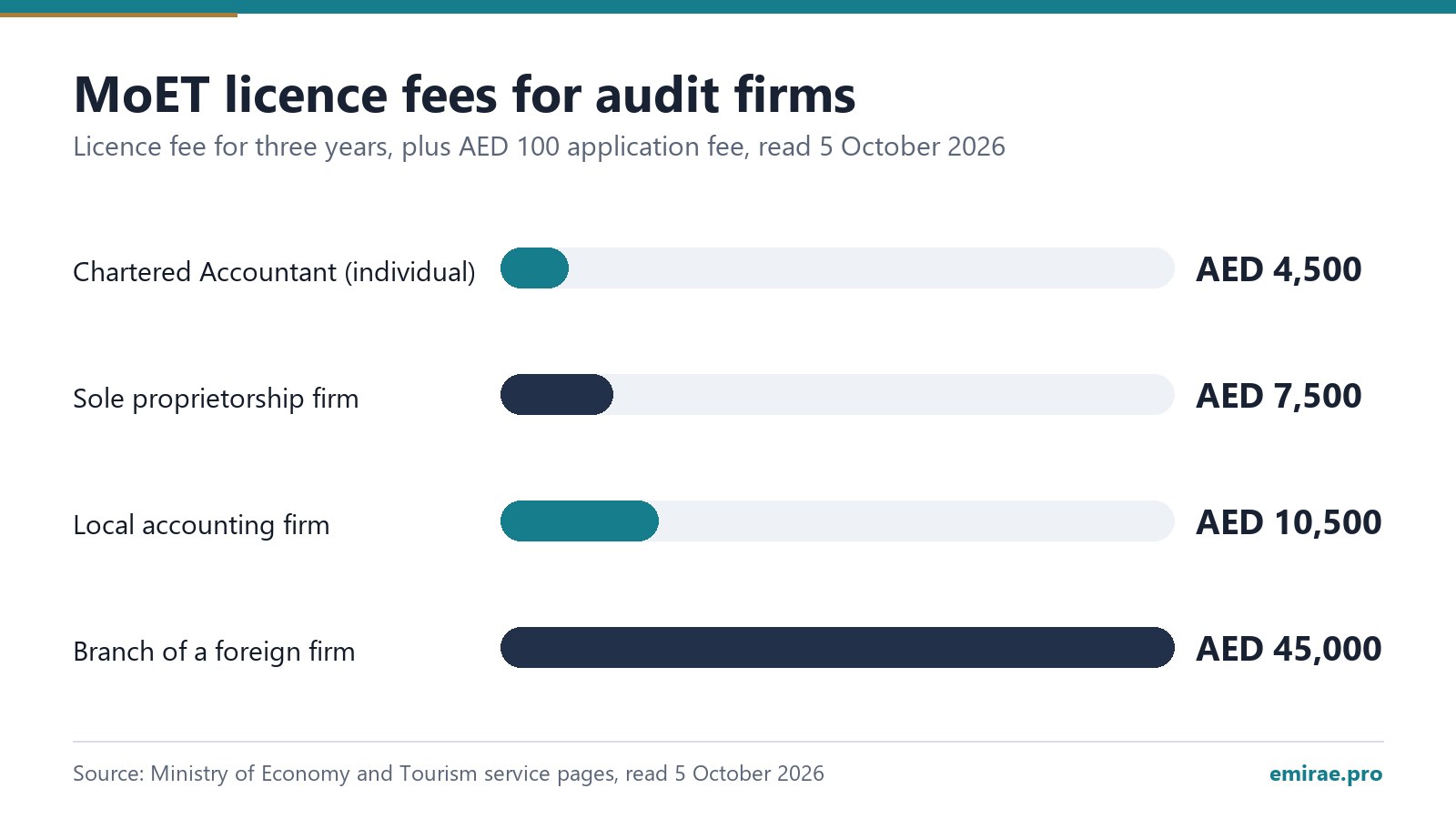
A local firm can only be formed by licensed Chartered Accountants: MoET’s local firm service states that all partners must be licensed by the Ministry, and a partner that is a legal entity from abroad must have been licensed in its home country for at least five years. The application needs the trade licence, a professional liability insurance policy in the firm’s name and the articles of incorporation in Arabic. Fees on MoET service pages, read on 5 October 2026:
| MoET licence | Application fee | Licence fee | Stated time |
|---|---|---|---|
| Chartered Accountant (individual) | AED 100 | AED 4,500 for three years | 3 working days |
| Local accounting firm (company) | AED 100 | AED 10,500 for three years | 3 working days |
| Local accounting firm (sole proprietorship) | AED 100 | AED 7,500 for three years | 3 working days |
| Branch of a local firm (company / sole proprietorship) | AED 100 | AED 7,500 / AED 6,000 for three years | 1 working day |
| Branch of a foreign accounting firm | AED 100 | AED 45,000 per branch for three years | 3 working days |
| Renewal, branch of a foreign firm | none stated | AED 7,500 per branch per year | 1 working day |
| Renewal, local firm | Fee field reads “N/A” | 1 working day | |
A foreign firm’s branch must hold a valid licence in its home country, be registered with the Ministry’s foreign companies register, and name an authorised representative for each UAE branch.
Nationality. Neither the Decree-Law nor the MoET service pages we read set a UAE-national ownership share for an audit firm. Article 34 lets the Cabinet fix Emiratisation rates for accounting firms; we found no such decision listed on the Ministry’s legislation page on 5 October 2026.
Professional Indemnity Insurance
The Decree-Law requires every firm to insure itself and its auditors against professional liability and to pay the premiums (Article 16.2.b). Ministerial Resolution No. 111 of 2022 (dated 13 September 2022), still listed by MoET, sets the minimum cover:
- AED 1,000,000 per year for a newly registered local company or branch of a foreign company;
- AED 500,000 per year for a newly registered sole establishment;
- after the first two years, cover follows annual audit fees: 100% of fees up to AED 20,000,000 and 120% above that;
- the policy must be kept for five years after a partner leaves or the firm closes, unless the auditor never had clients.
A firm whose renewed policy is not filed within 30 days of expiry has its registration suspended, together with the auditors working there.
The Full Route, Step by Step
- Each partner obtains the fellowship certificate and the MoET Chartered Accountant licence.
- Choose the base: mainland Dubai (Department of Economy and Tourism) or a free zone. DAFZ, for example, lists the activity “6920-001 Auditing of accounts” in its 2025 activity list.
- Arrange professional indemnity insurance at the minimum above.
- Apply for the trade licence and the firm’s MoET professional licence in step: MoET asks for a copy of the trade licence, while Article 14 requires the licensing authority to check the Ministry’s approval before it issues or amends the trade licence. Ask your licensing authority which document it needs first.
- Register on goAML and set up anti-money laundering procedures (see below).
- Apply to the free zone auditor lists you want to serve.
Free Zone Approved Auditor Lists
Many free zone companies may only use an auditor that their free zone accepts. Getting on these lists is a separate step:
- DMCC. The guidance note on approved auditors (PDF created 28 January 2026) requires a UAE trade licence permitting audit, a physical UAE office, and an audit partner accredited by MoET. Registration costs AED 3,000, paid in two halves of AED 1,520 including a AED 20 Knowledge and Innovation fee; renewal is AED 1,020 a year. Details in our guide to DMCC approved auditors.
- DAFZ. DAFZ states that its FZE and FZCO companies must use auditors approved by the authority. Its auditors list dated 17 September 2025 ends at serial number 178. DAFZ does not publish how a firm gets added; ask the authority directly.
- JAFZA. JAFZA’s audit report service (page dated 23 May 2024) says the report should be issued only by an auditor with a Dubai Economic Department licence. We found no approved auditor list on jafza.ae.
Anti-Money Laundering Duties
Auditors and accountants are designated non-financial businesses and professions (DNFBPs). MoET’s DNFBP guidelines (March 2026) name it as the supervisor of auditors and accountants on the mainland and in commercial free zones, and MoET says goAML registration is mandatory for DNFBPs. The Decree-Law itself requires a firm to run anti-money laundering procedures, report suspected fraud or money laundering found during its work (Article 16) and keep working papers for at least 10 years (Article 19). Under Federal Decree-Law No. 10 of 2025 on anti-money laundering, in force since 14 October 2025, a supervisor can fine a DNFBP AED 10,000 to AED 5,000,000 per violation. See goAML registration and AML compliance support.
Where Audit Demand Comes From
Ministerial Decision No. 84 of 2025 (dated 25 March 2025), for tax periods starting on or after 1 January 2025, requires audited financial statements from:
- every taxable person that is not a tax group and has revenue above AED 50,000,000 in the tax period;
- every Qualifying Free Zone Person, whatever its size (see qualifying free zone person);
- every tax group, as audited special purpose financial statements.
Free zone rules add more: DMCC companies must have their accounts audited by a DMCC-approved auditor and approved within six months of the financial year end (DMCC guidance note), and DAFZ and JAFZA companies submit an annual audit report (JAFZA charges AED 10 inside the zone and AED 20 outside for the submission service). Our guides to accounting requirements for UAE companies and audit firms in Dubai explain this from the client’s side.
Worked Example: Ministry Fees for a Two-Partner Firm
Two licensed auditors open a local firm and join the DMCC list. Our arithmetic, using only the official fees above:
- Chartered Accountant licences: 2 × (AED 100 + AED 4,500) = AED 9,200 for three years.
- Firm licence: AED 100 + AED 10,500 = AED 10,600 for three years.
- DMCC approved auditor registration: 2 × AED 1,520 = AED 3,040.
- Total: AED 9,200 + AED 10,600 + AED 3,040 = AED 22,840 before the trade licence, office, insurance premium and fellowship costs, none of which MoET publishes.
From year four each auditor’s renewal is AED 1,500 a year, so AED 3,000 for both, plus AED 1,020 a year for DMCC.
Checklist Before You Apply
- Degree certificate attested, plus 15 accounting credit hours if the degree is not in accounting
- Experience certificates covering five years of audit work
- Valid fellowship certificate and good conduct certificate
- Partner agreement and articles of incorporation in Arabic
- Trade licence with an audit activity
- Professional indemnity policy at AED 1,000,000 (or AED 500,000 for a sole establishment)
- AML policy, a named compliance contact and goAML access
- Applications to the free zone lists you need
What is not published
- The renewal fee for a local firm’s MoET licence (the service page shows “N/A”).
- A new executive regulation under Decree-Law No. 41 of 2023; the Ministry still lists the 2022 regulation of the old law.
- Any Emiratisation rate for accounting firms under Article 34.
- How a firm joins the DAFZ list, and whether JAFZA keeps a list at all.
- Trade licence costs for an audit activity in mainland Dubai or a free zone; ask for a written quote.
How New Audit Firms Find Clients
Free zone lists show who may sign, not who is good, so a new firm still has to win work. The steady sources are the companies that must be audited each year: Qualifying Free Zone Persons and companies above AED 50,000,000 revenue. On Emirae, companies post requests for audit and accounting work; listing your firm and sending offers are free, up to 20 offers in any 24 hours, and you pay once per client only after the client opens their contacts to you. Prices by category are on our pricing page, how it works explains the matching, and clients compare firms on our audit firms page. For other channels see lead generation for UAE service firms and free zone partner programmes. If you also run bookkeeping, read how to open an accounting firm in Dubai; if you form companies, see the corporate service provider licence.
Frequently asked questions
Who regulates audit firms in the UAE?
The Ministry of Economy and Tourism (MoET) licenses Chartered Accountants and accounting firms under Federal Decree-Law No. 41 of 2023, which replaced Federal Law No. 12 of 2014. The emirate or free zone issues the separate trade licence.
What does an auditor need to get a MoET licence?
MoET’s service page asks for a bachelor’s degree in accounting (or another degree plus 15 accounting credit hours), at least five years of audit experience after the degree, a valid fellowship certificate and good conduct. The fee is AED 100 plus AED 4,500 for three years.
How much is the MoET licence for an audit firm?
MoET lists AED 100 plus AED 10,500 for three years for a local firm, AED 7,500 for a sole proprietorship and AED 45,000 per branch for three years for a branch of a foreign firm (read on 5 October 2026).
How much professional indemnity insurance does a new audit firm need?
Ministerial Resolution No. 111 of 2022 sets AED 1,000,000 a year for a newly registered local company or foreign branch and AED 500,000 for a sole establishment. After two years the cover follows annual audit fees.
Does an audit firm need a UAE national partner?
Neither Federal Decree-Law No. 41 of 2023 nor the MoET service pages we read set a UAE-national ownership share. Article 34 lets the Cabinet set Emiratisation rates for accounting firms; we found no such decision listed by MoET on 5 October 2026.
Which companies must have audited accounts for corporate tax?
Under Ministerial Decision No. 84 of 2025, for tax periods from 1 January 2025: taxable persons with revenue above AED 50,000,000, every Qualifying Free Zone Person, and tax groups (special purpose financial statements).
Start receiving audit requests from UAE companies: list your firm for free and see what one client costs on our pricing page.
Official references used for context in this article.
- Ministry of Economy and Tourism: Federal Decree-Law No. 41 of 2023 on the Regulation of the Accounting and Auditing Profession (Official Gazette, 29 September 2023)
- Ministry of Economy and Tourism: Auditors legislations (read 5 October 2026)
- Ministry of Economy and Tourism: Professional License, Chartered Accountant (read 5 October 2026)
- Ministry of Economy and Tourism: Professional License, local accounting firm (read 5 October 2026)
- Ministry of Economy and Tourism: Professional License, branch of a foreign accounting firm (read 5 October 2026)
- Ministry of Economy and Tourism: Add a branch of local accounting firm (read 5 October 2026)
- Ministry of Economy and Tourism: Renewal of professional license, Chartered Accountant (read 5 October 2026)
- Ministry of Economy and Tourism: Renewal of a professional license, local accounting firm (read 5 October 2026)
- Ministry of Economy and Tourism: Renewal of a professional license, branch of foreign accounting firm (read 5 October 2026)
- Ministry of Economy: Ministerial Resolution No. 111 of 2022 on Conditions of Insurance Against Professional Errors (13 September 2022)
- Ministry of Finance: Ministerial Decision No. 84 of 2025 on Audited Financial Statements (25 March 2025)
- DMCC: Approved Auditor Rules guidance note (PDF created 28 January 2026)
- DAFZ: Auditors list (17 September 2025)
- DAFZ: Downloads, official auditors of DAFZ (read 4 October 2026)
- DAFZ: ISIC Activity Lists 2025 (June 2025)
- JAFZA: Audit Report Submission (FZE and FZCO) (23 May 2024)
- Ministry of Economy and Tourism: Register in goAML (read 5 October 2026)
- Ministry of Economy and Tourism: AML/CFT/CPF Guidelines for DNFBPs (March 2026)
- Central Bank of the UAE Rulebook: Federal Decree-Law No. 10 of 2025 on Anti-Money Laundering (effective 14 October 2025)

Need help with this?
Submit a request and receive tailored offers from verified UAE business consultants. Free, no obligation.